
No products in the cart.
-19%new
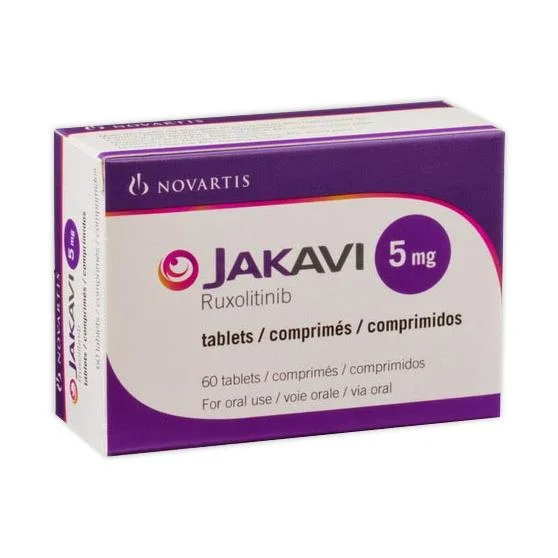
Jakavi 5mg (Ruxolitinib)
Jakavi 5mg is a high efficacy Myelofibrosis and Graft-Versus-Host Disease medicine. Buy Jakavi 5mg online at PakMeds with a valid prescription.
Original price was: ₨ 148,000.₨ 120,000Current price is: ₨ 120,000.
The 2nd dose of Gazyva is free for patients who qualify for the FOC program. Our team will guide you through the process.
Jakavi 5mg is a prescription oral JAK inhibitor tablet containing Ruxolitinib, used to treat intermediate or high-risk myelofibrosis, polycythemia vera resistant or intolerant to hydroxyurea, and steroid-refractory graft-versus-host disease. The 5mg strength is the starting dose for myelofibrosis patients with low platelet counts and the initial dose for graft-versus-host disease. Order Jakavi 5mg at PakMeds with a valid haematologist or oncologist prescription.
| Product Name | Jakavi |
|---|---|
| Manufacturer | Novartis Pharmaceuticals (also marketed as Jakafi by Incyte Corporation in the USA) |
| Active Ingredient | Ruxolitinib (as Ruxolitinib Phosphate) |
| Strength | 5 mg |
| Formulation | Oral Tablet |
| Available Strengths | 5 mg, 10 mg, 15 mg, 20 mg, 25 mg |
| FDA Approval | November 2011 (myelofibrosis); expanded 2014, 2019, 2021 |
| Prescription Required | Yes |
| Generic Name | Ruxolitinib |
Jakavi 5mg Ingredients and Usage
Jakavi 5mg contains Ruxolitinib phosphate, a selective oral inhibitor of the JAK1 and JAK2 protein kinases, in a tablet strength of 5mg Ruxolitinib free base. Each tablet includes the inactive ingredients microcrystalline cellulose, lactose monohydrate, magnesium stearate, colloidal silicon dioxide, sodium starch glycolate, povidone, and hydroxypropyl cellulose. Ruxolitinib belongs to the Janus kinase (JAK) inhibitor drug class and was first approved by the FDA in November 2011 as the first treatment for intermediate and high-risk myelofibrosis.
Jakavi 5mg is indicated for four conditions. It treats intermediate or high-risk myelofibrosis (MF) in adults, including primary myelofibrosis, post-polycythemia vera myelofibrosis, and post-essential thrombocythemia myelofibrosis. It treats polycythemia vera (PV) in adults who have had an inadequate response to or cannot tolerate hydroxyurea. It treats steroid-refractory acute graft-versus-host disease (aGVHD) in adults and children aged 12 and older. It also treats chronic graft-versus-host disease (cGVHD) after the failure of one or two prior lines of systemic therapy in adults and children aged 12 and older.
The 5mg strength is the prescribed starting dose for myelofibrosis patients with a baseline platelet count between 50 and 100 x 10^9/L, at a maximum of 5mg twice daily. It is also the starting dose for acute GVHD treatment, beginning at 5mg twice daily for 3 days before increasing to 10mg twice daily. For chronic GVHD, 10mg twice daily is the recommended dose. The 5mg strength is additionally used as a reduced maintenance dose following dose adjustments triggered by cytopenias or drug interactions. Jakavi tablets are taken orally with or without food. Jakavi must never be taken with grapefruit or grapefruit juice due to CYP3A4-mediated increases in Ruxolitinib plasma exposure.
How Does Jakavi 5mg Work?
Janus kinases (JAKs) are enzymes that attach to cytokine receptors on blood cell precursors and relay growth and proliferation signals into the nucleus via the JAK-STAT signalling pathway. In myelofibrosis and polycythemia vera, somatic mutations — most commonly the JAK2V617F mutation — cause constitutive overactivation of JAK1 and JAK2. This drives abnormal blood cell production, progressive bone marrow fibrosis, dangerous splenomegaly, and systemic inflammatory symptoms including night sweats, pruritus, and fever. Ruxolitinib in Jakavi 5mg selectively blocks both JAK1 and JAK2, interrupting this dysregulated cascade at the enzyme level.
By inhibiting JAK1 and JAK2, Ruxolitinib reduces STAT protein phosphorylation and suppresses the downstream gene expression that drives myeloproliferative cell growth. In the pivotal Phase 3 COMFORT-I trial, 41.9% of myelofibrosis patients achieved a 35% or greater reduction in spleen volume at 24 weeks versus just 0.7% of placebo patients. In the same trial, 45.9% of Ruxolitinib-treated patients achieved a 50% or greater improvement in total symptom score at week 24, compared to 5.3% on placebo. These benefits were sustained on continued therapy, and symptoms returned to baseline within 1 week of stopping treatment — which is why Jakavi must never be discontinued abruptly.
In graft-versus-host disease, overactive JAK-STAT signalling drives the expansion and activation of donor immune cells that attack the transplant recipient’s tissues. Jakavi suppresses this inflammatory immune process. In polycythemia vera, Ruxolitinib controls erythrocytosis and significantly reduces thromboembolic risk — in the Phase 3 PV trial, only 1 of 110 patients on Ruxolitinib experienced a thromboembolic event through week 32, versus 6 of 112 patients in the control arm.
Jakavi 5mg Side Effects
Jakavi causes dose-dependent cytopenias as its primary adverse effect. Even at the 5mg dose, blood cell counts require monitoring before and throughout treatment. The most commonly reported side effects from the COMFORT myelofibrosis and Phase 3 PV clinical trials are listed below.
- Thrombocytopenia — low platelet counts causing bruising and prolonged bleeding
- Anaemia — low red blood cell counts causing fatigue, pallor, and shortness of breath
- Neutropenia — low white blood cell counts raising infection risk
- Bruising and minor bleeding events
- Dizziness and headache
- Diarrhoea and abdominal discomfort
- Weight gain
- Elevated cholesterol (hypercholesterolaemia) and triglycerides (hypertriglyceridaemia)
- Raised liver enzyme levels (ALT and AST)
- Infections including urinary tract infections, upper respiratory infections, and herpes zoster reactivation
- Peripheral oedema (swelling of the limbs) particularly in GVHD patients
- Non-melanoma skin cancers reported in some patients on long-term JAK inhibitor therapy
Warnings
- Myelosuppression and cytopenias: Jakavi 5mg causes thrombocytopenia, anaemia, and neutropenia. Complete blood counts must be obtained before starting treatment and at regular intervals throughout. Dose reduction or interruption is required when platelet counts or haemoglobin fall below defined thresholds. Jakavi must not be initiated in patients with platelet counts below 50 x 10^9/L.
- Serious infections: Jakavi increases the risk of serious bacterial, fungal, viral, and opportunistic infections. Herpes zoster reactivation, tuberculosis reactivation, and progressive multifocal leukoencephalopathy (PML) — a potentially fatal brain infection — have been reported with Ruxolitinib. Active serious infections must be fully resolved before starting Jakavi. Patients must call their doctor immediately if they develop fever, chills, sore throat, painful skin rash, or any other signs of infection.
- Abrupt discontinuation: Stopping Jakavi suddenly causes rapid return of myelofibrosis and PV symptoms within 1 week, including splenomegaly, fever, and constitutional symptoms. Patients must never stop taking Jakavi without medical guidance. Gradual dose tapering under specialist supervision is always recommended.
- Drug interaction — strong CYP3A4 inhibitors: Strong CYP3A4 inhibitors such as ketoconazole increase Ruxolitinib AUC by up to 91%. When Jakavi is coadministered with strong CYP3A4 inhibitors in patients with platelet counts above 100 x 10^9/L, the starting dose must be reduced to 10mg twice daily. Jakavi must be avoided entirely in patients on strong CYP3A4 inhibitors with platelet counts below 100 x 10^9/L.
- Drug interaction — strong CYP3A4 inducers: Strong CYP3A4 inducers such as rifampin reduce Ruxolitinib AUC by 61%, substantially lowering therapeutic efficacy. Patients must be closely monitored and doses titrated based on clinical response when these agents are coadministered.
- Drug interaction — fluconazole: Coadministration of Jakavi with fluconazole at doses above 200mg daily must be avoided due to significantly increased Ruxolitinib exposure. If fluconazole 200mg or below is necessary, a Jakavi dose reduction is required.
- Drug interaction — grapefruit: Jakavi 5mg must not be taken with grapefruit or grapefruit juice. Grapefruit inhibits intestinal CYP3A4 metabolism and raises Ruxolitinib plasma levels unpredictably, increasing the risk of severe cytopenias.
- Cardiovascular and thrombotic risk: Based on data from other JAK inhibitors used in rheumatoid arthritis, there is a possible increased risk of major cardiovascular events and venous thromboembolism in patients with cardiovascular risk factors who smoke or have smoked. Patients with these risk factors must discuss benefit-risk assessment with their treating haematologist before starting Jakavi.
- Non-melanoma skin cancers: Basal cell carcinoma and other non-melanoma skin cancers have been reported in patients on long-term JAK inhibitor therapy. Periodic skin examination is recommended throughout prolonged Jakavi treatment.
- Pregnancy: Animal embryofetal studies with Ruxolitinib showed reduced fetal weights and increased late resorptions at maternally toxic doses. There are no adequate controlled studies in pregnant women. Women of childbearing potential must use effective contraception during Jakavi treatment. Jakavi should be used in pregnancy only when the potential clinical benefit clearly outweighs the risk to the fetus.
- Breastfeeding: Ruxolitinib and its metabolites are excreted in rat milk at concentrations 13 times the maternal plasma level. Women must not breastfeed during Jakavi treatment or for at least 2 weeks after the final dose.
- Renal and hepatic impairment: Dose reductions are required in patients with moderate to severe renal impairment (creatinine clearance 30 to 59 mL/min for PV patients). Patients with hepatic impairment and platelet counts between 100 and 150 x 10^9/L also require dose reduction. Patients on haemodialysis must take Jakavi after dialysis, not before.
- Lactose content: Jakavi tablets contain lactose monohydrate. Patients with rare hereditary conditions of galactose intolerance, total lactase deficiency, or glucose-galactose malabsorption should not take this product.
Jakavi 5mg Storage Conditions
Store Jakavi 5mg tablets at room temperature between 20°C and 25°C (68°F to 77°F). Brief excursions between 15°C and 30°C (59°F to 86°F) are permitted. Keep tablets in the original container with the lid tightly closed to protect them from moisture. Do not refrigerate or freeze Jakavi tablets.
Keep Jakavi 5mg away from direct sunlight, heat sources, and damp environments such as bathrooms. Store all tablets out of reach of children. Do not use Jakavi past the expiry date printed on the packaging. Dispose of unused or expired tablets through your pharmacist or as directed by applicable pharmaceutical waste disposal procedures in your region.
Reviews
There are no reviews yet.
Jakavi 15mg (Ruxolitinib)
Original price was: ₨ 547,393.₨ 270,000Current price is: ₨ 270,000.
(0 customer reviews)